The system card of Marion Michielen and Per-Ola Cullin
GUUS SCHREIBER
Guus Schreiber is a professor of Computer Science, who has played at the highest level in Dutch bridge competitions despite his eyesight of 10%.
In this series, we examine the system card of a top international pair. From the pair’s system, we select a number of interesting, lesser-known agreements for common bidding situations. We outline the basic structure of these agreements, so readers can use these as an inspiration and develop their own version in more detail as they see fit.
Per-Ola Cullin and Marion Michielsen
Per-Ola Cullin (1979) studied law at Lund University and works at the Swedish Ministry of Justice. He lives in Stockholm with his partner Julia and their two children Alma and Olof. He won many national and international bridge tournaments. In 2012 he collected the gold medal with the Swedish open team at the World Bridge Games in Lille, and finished third in the 2025 Bermuda Bowl in Herning. He played a key role in unravelling the cheating methods of Fisher – Schwartz.
Marion Michielsen (1985) holds a Master in Law from the Erasmus University in Rotterdam. She lives in Stockholm with her son Oscar. Marion is a professional bridge player. She won three junior titles and won the European Championships for women thrice (2007, 2014 & 2015, with Meike Wortel). In 2014 she also triumphed both in the Women Teams (with Meike Wortel) and in the Mixed Teams (with Zia Mahmood) at the World Bridge Series (Sanya, China). In 2022 she won the Women Teams event (with Cecila Rimstedt) at the World Bridge Series in Wroclaw. She won bronze at the 2025 Bermuda Bowl with the Swedish open team.
The partnership
Marion and Per-Ola have been bridge partners since 2014. They finished second in the Open BAM on Hawaii in 2018. In 2020 they qualified for the Swedish open team to play in the European Championships on Madeira, but this tournament was cancelled due to COVID-19. They won a bronze medal in the Mixed Teams event of the 2022 World Bridge Series in Wroclaw. In 2022 they made their debut in the Swedish open team; in 2025 they finished third in the Bermuda Bowl in Herning, Denmark. Recently they took the Reisinger Trophy in San Francisco.
System basics
Marion and Per-Ola play a strong-club system, originally developed by Daniel Auby and Johan Ebenius. The system uses a special counting method called ‘zz’: 3 points for an ace, 2 points for a king, and 1 point for a queen. HCP counts are associated with zz ranges; this can help to evaluate a hand. For example, a hand with 12 HCP is expected to have a zz-range of 6-8. A hand like  A x x x
  K Q x
K Q x  K x
K x  x x x x is thus considered a good 12 count, K Q x x Q J x K x J x x x a poor one. A hand such as K Q x x Q J x J x Q J x x (only 5 zz) should be downgraded to 11 HCP, which intuitively makes sense. 12 HCP with three aces should be upgraded.
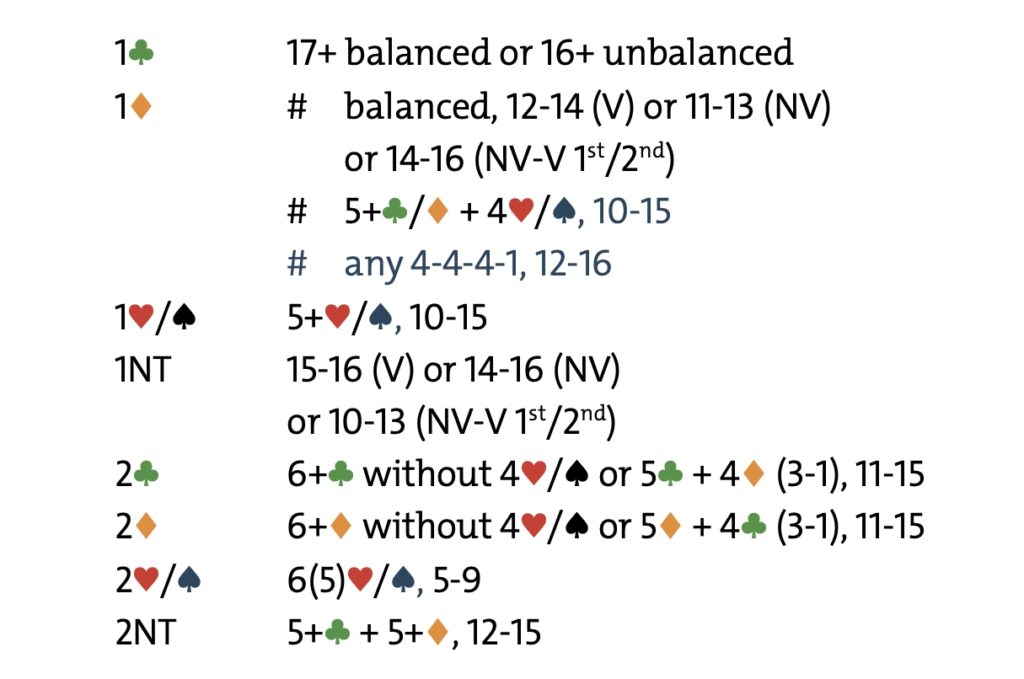
Marion and Per-Ola have refined the Auby-Ebenius system to their own taste. This is the schema of their opening bids:
After the 1 opening they employ an extensive system of relays. Like most top pairs they have integrated a weak NT (10-13) into their system. Hands with opening bid values and predominately minor-suit length are opened at the two-level (2, 2, 2NT), which therefore have some pre-emptive value. The 1 opening is a catch-all for hands in the 11-16 range not covered by other opening bids.
In this article we focus on a number of agreements that Marion and Per-Ola made for a contested auction.
1/-2NT in competition
Nowadays, most pairs play a 2NT response to a major opening bid or overcall as some sort of support for the major. In a non-contested auction there are typically many ways to show support, and is it relatively easy to specify strength and shape. For example, the Maas 2NT bid, popular in The Netherlands, shows a limited hand; with strong hands and major support you bid something else. However, in a competitive auction you do not have this luxury, and 2NT typically becomes a bid with a relatively wide range, both in strength and in shape. This is also because jumps to four of a new minor are usually not defined as a splinter bid, but rather as a ’fit bid’ (5+ in the minor plus major support), to help partner make the right decision.
Marion and Per-Ola have developed a schema for a 2NT support bid after intervention. Opener/overcaller shows his strength, and responder can subsequently ask or show (non-)shortness. Below you find the schema after a 1 opening bid and a non-jump intervention by the opponents:
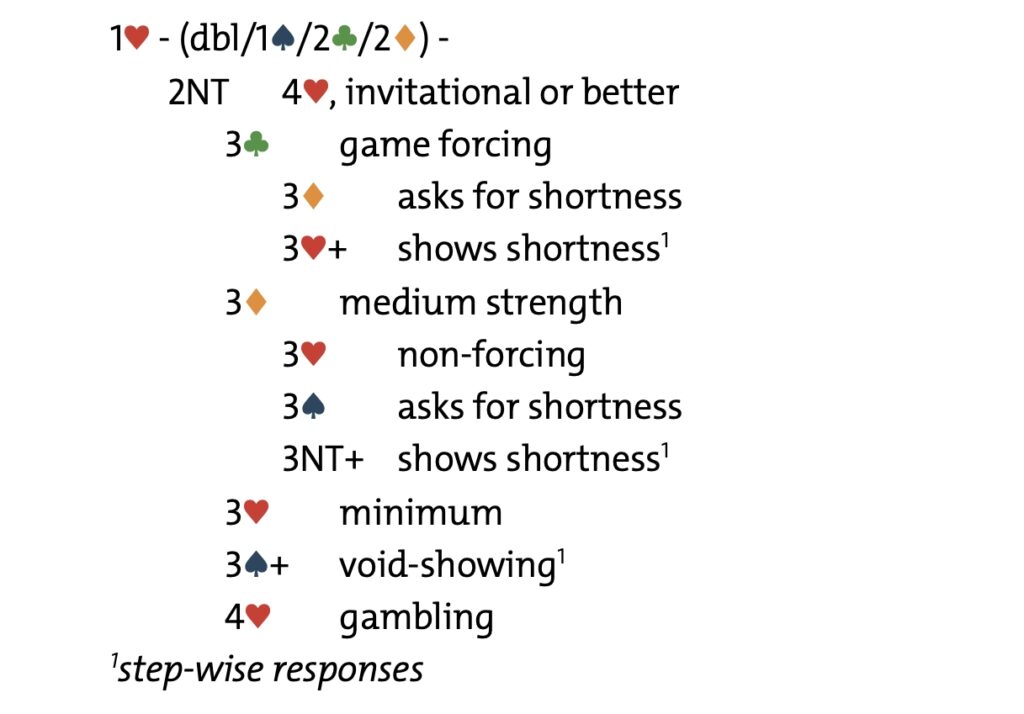
2NT shows a hand with four-card support for the major and invitational or better values. Opener usually responds by indicating his strength, using the principle ‘lower is stronger’. Then responder can either ask for shortness or show shortness. The details of the responses should be aligned with your partnership agreements in such situations. For example, if you bid short suits from low to high, using the first step to indicate ‘no shortness’ if that is still a possibility, the details after the 3-response would look like this:
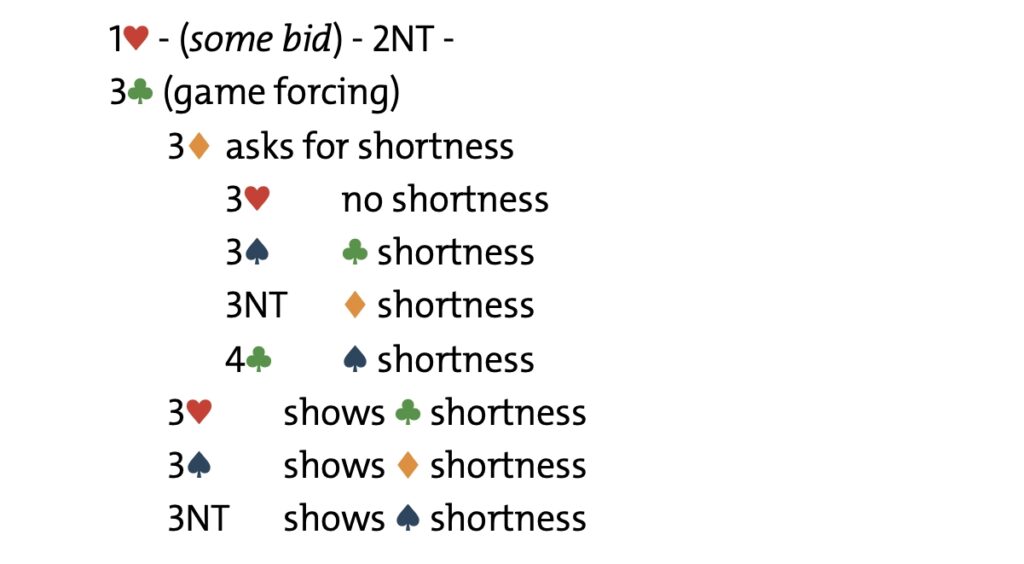
Note that you should strive to memorise only the general schema above, and derive the details at the table, when needed. This saves valuable memory space.
You can use the same schema when your partnership overcalls 1/. If the opening bid or the overcall is 1, you have, compared to 1, an extra bid to indicate strength. Marion and Per-Ola use 3 to show the upper range of a medium-strength hand and 3 for the lower range. Apart from that the response schema after a 1 opening bid or overcall is basically the same as over 1.
The hand below is from the World Bridge Tour Masters 2025 in Copenhagen.
Q J 10 9K J 8 6A 10 8K 7--Q 10 7 5 3K Q J 7A 10 4 2K 5A 4 29 6 2Q 9 6 5 3A 8 7 6 4 3 295 4 3J 8| West | North | East | South |
|---|---|---|---|
| Marion | Per-Ola | ||
| pass | 1 | ||
| 1 | 2NT1 | pass | 32 |
| pass | 3NT3 | pass | 4 |
| pass | 44 | pass | 4NT |
| pass | 5 | pass | 6 |
| all pass |
1 4+, invitational or better
2 void in suit of opponents
3 serious
4 last train
Most pairs show shortness from low to high. Marion and Per-Ola employ a different sequence order: if the opponents have bid a suit, then this suit becomes the first one when showing shortness. The rationale is that this is the suit in which you will most frequently have shortness, thus preserving maximum bidding space. After the void in spades has been shown the path to slam on this board is reasonably straightforward.
Responding to a take-out double after (1♥/♠) dbl (2♥/♠)
Consider the situation where partner makes a take-out double of a major opening bid and right-hand opponent raises. You could easily have the majority of the points, but space for finding the right spot is tight. A popular approach in this situation is (i) to use 2NT as Lebensohl with primarily weak hands, (ii) treat direct three-level bids as forward-going, and (iii) treat double as responsive. Establishing a major fit can be quite tricky however, especially if the opponents’ suit is spades (for example, see board 27 in Tim Verbeek’s article on the EC in Poznan, IMP 25-6 p. 41).
Marion and Per-Ola use another schema, inspired by Simon Hult, which puts emphasis on the invitational and game-forcing hands:
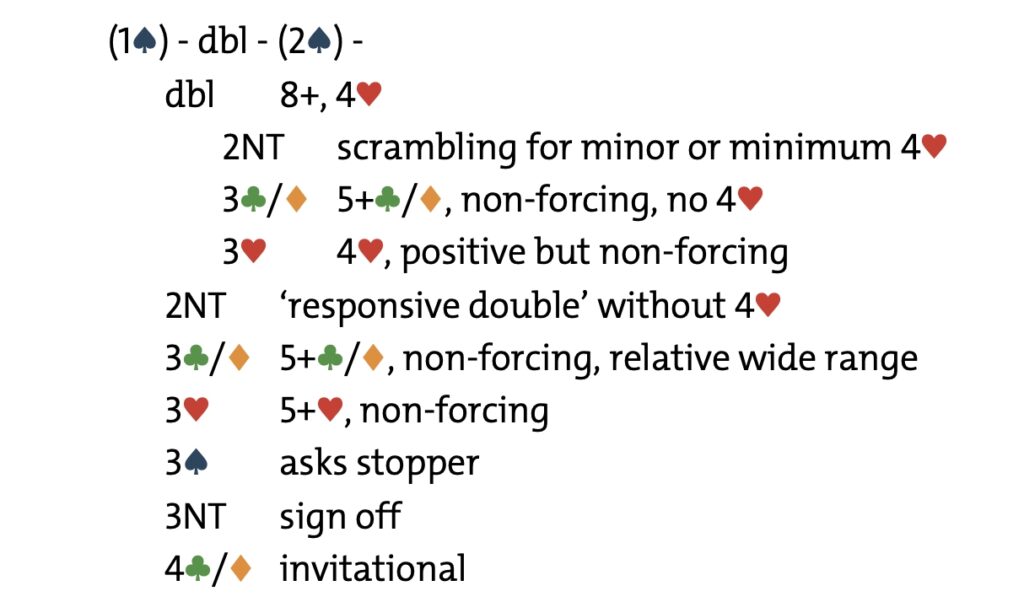
With a positive hand and four hearts you always start with a double. This provides a lot of clarity, also as to the other responses. 2NT is not Lebensohl, but is treated as a ‘responsive double’ without four hearts. The price you pay for this schema is that the direct three-level bids in a minor have a relative wide range; especially when vulnerable these bids should not be made with very weak hands.
You can use a similar schema after (1) dbl (2). That situation is a bit easier, because you now have 2 to show a modest hand with spades, and a jump to 3 to show five spades with invitational values.
The hand from the Open EC in Poznan mentioned above would have been bid in the following way using the schema of Marion and Per-Ola (board rotated for convenience):
J10 2K 10 7 5 4Q 8 7 5 3Q 9 8A K Q 5A 8 6 3A 4| West | North | East | South |
|---|---|---|---|
| pass | 1 | ||
| dbl | 2 | 2NT1 | 3 |
| dbl | pass | 4 | pass |
| 5 | all pass |
1 responsive double without 4♥
West knows that partner does not have four hearts. Double shows extra values, not wishing to bypass 3NT. East could now propose 4 with, say, 5-4-3-1 and three hearts. With the actual hand a promising 5 is reached.
Responding to 3♠ overcall after minor pre-empt
In recent years three-level pre-empts have become much more frequent, so defending against this should be an important part of your competitive system repertoire. Let’s discuss the situation when opponents open three of a minor. If you have five hearts and sufficient values, you can overcall 3 even if you hold some support for spades, as partner still has room for a 3-bid. But the situation is more difficult after an overcall of 3. Assume you hold as partner of the overcaller Q x A Q J x x K x x x x. You would like to introduce your hearts, but would not want to give up the possibility of ending up in 4. But now assume you hold x K Q J x x x A x x x x x. You would like to bid 4 without partner correcting this to 4. Some players try to solve this problem by doubling the minor preempt with five spades and three hearts, but that approach has its own problems.
Marion and Per-Ola have an elegant agreement for this particular situation: they use 4 as a ‘flexible’ heart bid, and 4 as a unilateral heart bid:
Of course, this agreement comes with a price: you cannot show the unbid minor at the four level. Marion and Per-Ola cater for this to a limited extent. With 5+ in the unbid minor and spade tolerance they also bid 4. If overcaller now bids 4, they correct to 4 to show this hand type. If overcaller would have a 5-4-3-1 with three hearts and a four card in the unbid minor he could correct to five of the minor suit. The adapted schema looks like this (assuming a 3 opening):
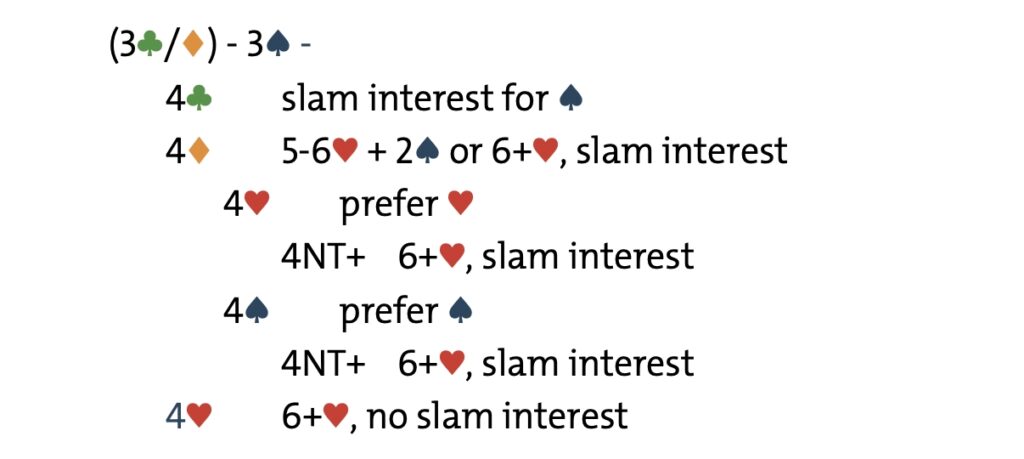
The use of 4 in competition as a good raise of partner’s major suit has become quite popular, and is also used by Marion and Per-Ola. In addition, they use in this particular situation 4 as initially showing 5-6 hearts with spade tolerance. The overcaller now selects the most promising major contract. Responder may continue with 4NT (RKCB) or a five-level bid if he originally held 6+ with slam interest. A direct 4 bid by responder shows long hearts without slam interest; partner will usually pass.
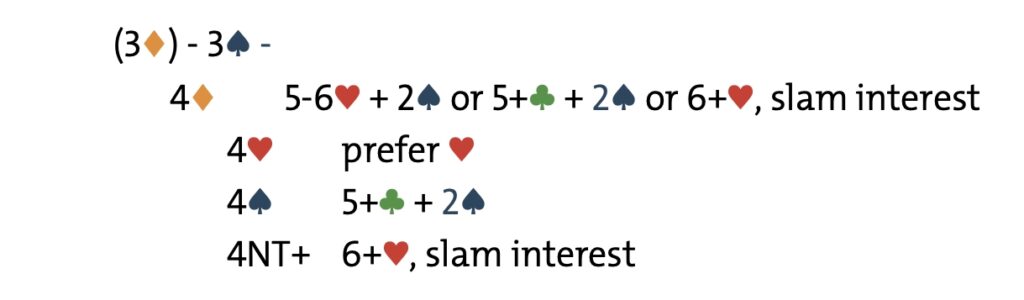
This approach only helps if overcaller has both support in hearts and length in the unbid minor, which will often not be the case. You could reverse the meaning of 4 and 4 to solve this problem, but the price you pay for this (i.e., an exception to a general rule) is high, and you probably do not want to pay it.
The system book of Marion of Per-Ola has many more nice things to offer, but we leave it at this. IMP thanks them for giving us insight into their bidding methods.
 Guus Schreiber
 24-03-2026